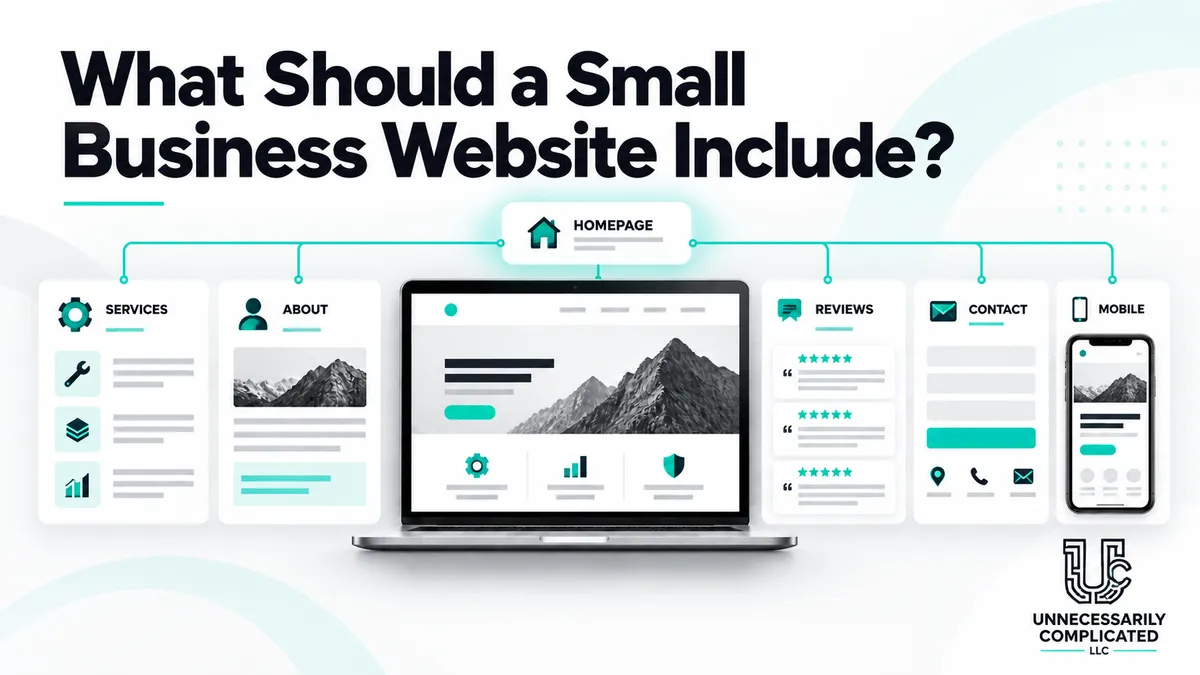
What Should a Small Business Website Include?
A useful small business website does not need dozens of pages or every feature a platform can sell you. It needs to answer the right questions quickly, build trust, and give visitors a clear next step. The strongest sites feel simple because the important decisions were made before the design began.
The homepage should explain the business immediately
A visitor should understand what you do, who you help, and where you work within a few seconds. A clear headline beats a clever slogan. Follow it with a short explanation, one primary call to action, and enough proof to make the next click feel safe. If the opening section could describe almost any company, it is too vague.
Dedicated service pages
A single paragraph listing every service rarely gives customers or search engines enough information. Create a focused page for each core service. Explain the problem, what the service includes, who it is for, the typical process, and the next step. These pages also give you useful destinations for Google Business Profile links, blog posts, ads, and follow-up messages.
An About page that builds confidence
Your About page is not filler. It should show that a real, capable business stands behind the website. Explain why the company exists, what experience shapes the work, how customers are treated, and what makes the approach different. Use authentic photos when possible. Visitors are trying to decide whether they trust you, not study a corporate autobiography.
Proof that reduces uncertainty
Testimonials, project examples, certifications, affiliations, guarantees, recognizable customers, and before-and-after work can all strengthen credibility. Use only proof you can support. A few specific examples are more persuasive than a wall of generic praise.
Simple contact options
Include the contact method your customers actually prefer: phone, form, booking link, directions, or email. Keep forms short. Ask only for information needed to begin the conversation. Confirm that submissions work and tell people what happens next.
Mobile usability and accessibility
Every important action should work comfortably on a phone. Text must be readable, buttons easy to tap, menus predictable, images properly sized, and forms usable without zooming. Add descriptive alt text, logical headings, sufficient contrast, and labels that make sense outside of the design.
Basic search and analytics foundations
Each page needs a descriptive title, one clear primary heading, a useful meta description, clean internal links, and content written around real customer questions. Connect analytics and Search Console so you can see what people find, where they leave, and which pages deserve improvement.
The simplest complete website wins
A complete small business website is not the one with the most pages. It is the one that makes the business easy to understand and easy to contact. Start with the essentials, make them work well, and expand only when a new page or feature serves a clear purpose.
Ready to make your website less complicated?
Unnecessarily Complicated LLC designs professional small business websites and rescues outdated, confusing, or underperforming sites. Explore Website Design, learn about Website Rescue, or contact us to talk through what is getting in the way.
Suggested links: https://www.unnecessarilycomplicated.com/website-design | https://www.unnecessarilycomplicated.com/website-rescue | https://www.unnecessarilycomplicated.com/contact
